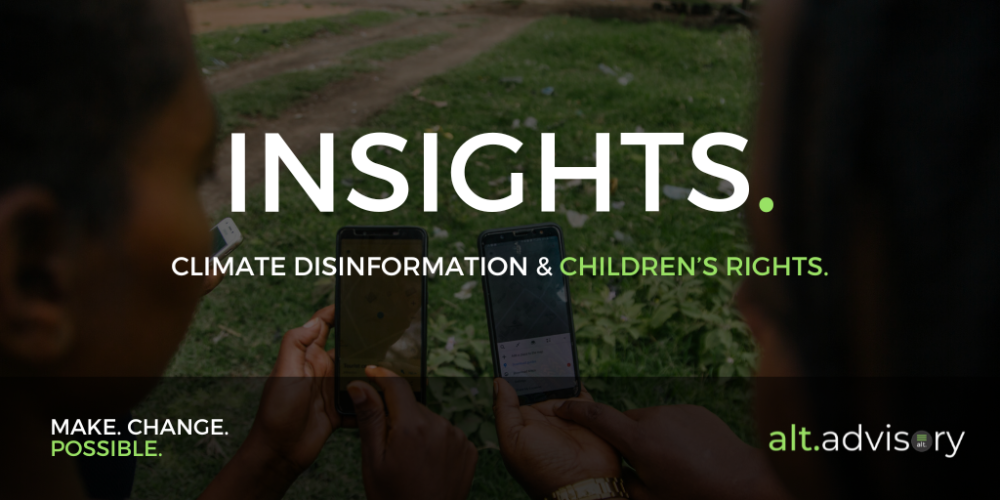
Tackling climate disinformation as a children’s rights issue
A new article by Power Law Africa’s Claire Dehosse and Phenyo Sekati, together with Phakamile Khumalo from Media Monitoring Africa, looks at climate disinformation through the lens of children’s rights, and examines the implications for children’s ability to participate in environmental decision-making. The article forms part of a new publication from the African Committee of Experts on the Rights and Welfare of the Child, marking the 35th anniversary of the African Charter on the Rights and Welfare of the Child.
* * *
 Introduction
Climate mis- and disinformation are currently clear threats to children’s rights across Africa. As the continent most vulnerable to climate change,[1] African children are entitled to access accurate and reliable information to make informed choices that enable them to meaningfully participate in decision-making. Instead, they increasingly encounter false or misleading climate narratives on digital platforms, where engagement-driven algorithms amplify sensational content over scientific accuracy. Social media echo-chambers entrench these narratives, where deceptive claims are framed as credible insights and sow sufficient seeds to doubt credible evidence.[2]
This article examines how climate mis- and disinformation undermines children’s rights under the African Charter on the Rights and Welfare of the Child (the Charter) and, drawing on insights from children themselves as well as recent research on media and information literacy (MIL), provides recommendations to counter these adverse effects in order to empower children and their caregivers to critically engage with online content and meaningfully participate in shaping Africa’s future.
Implicated rights
Article 4 of the Charter establishes that the best interests of the child must be the primary consideration in all actions affecting them and guarantees children the right to express their views and participate in all judicial and administrative proceedings which affect them. Article 7 grants children the right to express their opinions freely in all matters. Article 11 states that every child shall have the right to education which is directed to the development of respect for the environment and natural resources. State Parties must take all appropriate measures to achieve this.[3]
Climate mis- and disinformation comprises these rights. When children do not have access to reliable and accurate climate information, their participation on climate related issues becomes limited or uninformed. Further, their right to meaningful education is undermined. These rights and the corresponding risks of mis-and disinformation are echoed in other African Union and international law instruments. For example, the African Union Child Online Safety and Empowerment Policy provides strategic imperatives for comprehensive national action plans for the protection of children online, recognising both the risks (including mis- and disinformation) and opportunities that digital platforms may present.[4] In 2023, the United Nations Committee on the Rights of the Child, in General Comment No. 26 on Children’s Rights and the Environment, stated that children have the right to access accurate and reliable environmental information, and that States must protect children from misinformation concerning environmental risks.[5]
The impact of climate mis-and disinformation on children
It must be borne in mind that children’s cognitive capacities are still evolving, making them particularly susceptible to the impacts of climate mis – and disinformation.[6] In many African countries, digital platforms are used as primary sources of information.[7] However, these platforms present structural problems which result in the dissemination of content that is not always accurate or reliable. For example, many platforms make use of automated tools to flag and remove content which is contrary to their terms of use.[8]
These tools are often not nuanced enough to capture different languages or cultural contexts. Because of this and platforms’ general disincentive to flag climate mis- and disinformation, such content often remains unchecked.
Further, climate mis- and disinformation campaigns have moved past mere climate change denial. Sophisticated campaigns are now used to minimise urgency, promote false solutions, exploit legitimate grievances, and use cultural narratives to dismiss climate science.[9] This complexity makes it harder to detect and subsequently remove climate mis- and disinformation from digital platforms.[10]
Consequently, children are hindered from making informed decisions and participating meaningfully in online spaces. These effects extend beyond individuals when echo-chambers encourage peer groups to share false beliefs that, in turn, normalise disinformation. This contributes to mistrust in the media, primes children to distrust climate science, and undermines the effectiveness of climate mitigation and adaptation measures.[11]
Recommendations: MIL Education and the Article 12 case study
MIL education is a crucial defence against mis – and disinformation on digital platforms. The United Nations Educational, Scientific and Cultural Organization (UNESCO) presents MIL as an umbrella term that encompasses competencies that relate to information and communication broadly, and media in particular. MIL highlights “Access”, “Analyse”, and “Reflect” competencies, which emphasise critical thinking, questioning, and verifying information. It further emphasises “Create” and “Act” competencies, which have the potential to equip learners with fact-checking skills and the ability to navigate conflicting narratives, resist emotional manipulation, and use accurate information to support environmental justice.[12]
Recent research by the Media Monitoring Africa Trust (MMA) provides key insights into how MIL develops critical thinking, source credibility assessment, and fact-checking skills that help children combat climate disinformation and build resilience.[13] The study used mixed qualitative methods to assess South African learners in two provinces: the Gauteng-based Article 12 Policy Working Group (Article 12),[14] learners trained in digital and media literacy, and a group of KwaZulu-Natal learners without such training.
The findings highlight stark differences. Article 12 learners showed more advanced skills in critical thinking and information verification, while the other learners showed significant gaps. Specifically, Article 12 learners were better equipped to navigate complex information than the KZN-based learners, who demonstrated limited critical thinking and vulnerability to disinformation. This demonstrated an emerging information elitism, which separated South African children into those who could evaluate sources critically and those prone to manipulation.
Overall, the Article 12 learners’ skill set provides compelling evidence that structured MIL training builds strong resilience against climate disinformation. In the group’s three years of training, they had actively engaged in counter- disinformation efforts, thereby positioning themselves as community agents who could disseminate accurate information. Beyond community engagement, Article 12 members also participate in ICT policy submissions and discussions to ensure that children’s voices influence policymaking. Their recent submission to the United Nations Committee on the Rights of the Child on General Comment No. 26 emphasised the importance of MIL in equipping young people to identify and respond to climate mis- and disinformation by framing climate change as a rights issue requiring children’s access to accurate, updated, and age-appropriate environmental information. They also called for public campaigns and youth competitions to raise awareness and provide reliable climate information.[15]
MIL for children is essential in strengthening digital literacy, thereby empowering children to critically engage with their communities, challenge climate mis – and disinformation, and ultimately in upholding their rights. State Parties should, in upholding the Charter, implement similar programmes to achieve these outcomes.
Conclusion
Climate mis- and disinformation violate children’s rights under the Charter by corrupting their access to reliable information, undermining their participation in decisions affecting their futures, and polluting their educational environment. These challenges are substantial, but not insurmountable. Effective digital literacy through MIL programmes and other mechanisms such as community engagement and platform accountability can transform the information ecosystem. These interventions respect children’s agency while providing them with tools to navigate complex information environments.
Today’s children, and children to come, will inherit a climate crisis that they did not create. Whether they have the knowledge and agency to address it depends on actions taken now. Empowering African children to critically engage with climate information is a rights obligation under the Charter, as well as a practical necessity for the continent’s future.
- Claire Dehosse is an Associate, and Phenyo Sekati is a Candidate Legal Practitioner, at Power & Associates Inc. Phakamile Khumalo is Public and Media Skills Development Manager for Media Monitoring Africa / Moxii Africa.
[1] World Meteorological Organization, ‘Africa faces disproportionate burden from climate change and adaptation costs’ (2024) (accessible here).
[2] Ruiz and Nilsson, ‘Disinformation and Echo Chambers: How Disinformation Circulates on Social Media Through Identity-Driven Controversies’ (2023) 42(1) Journal of Public Policy and Marketing (accessible here) at page 32.
[3] See articles 4, 7 and 11 of the African Charter on the Rights and Welfare of the Child respectively (accessible here).
[4] African Union, ‘The African Union Child Online and Safety and Empowerment Policy’ (2024) (accessible here) at pages 4, 6-7.
[5] Committee on the Rights of the Child, ‘General Comment No. 26 (2023) on Children’s Rights and the Environment with a Special Focus on Climate Change’ (2023) (accessible here) at para F. For more on international and regional guidance on climate change and children’s rights, see Media Monitoring Africa, ‘Climate Disinformation: Consequences and Solutions’ (2024) (accessible here).
[6] Media Monitoring Africa, ‘Disinformation through a children’s rights lens’ (2022) (accessible here) at 20.
[7] Reuters Institute, ‘Digital News Report’ (2025) (accessible here).
[8] ALT Advisory, ‘Context matters: The importance of local nuance in online content moderation’ (2023) (accessible here).
[9] UNESCO, ‘Countering climate disinformation in Africa through Media and Information Literacy’ (2025) (accessible here).
[10] Media Monitoring Africa, see above n 6 at page 14.
[11] Media Monitoring Africa, see above n 5.
[12] UNESCO see above n 9.
[13] Media Monitoring Africa, ‘Building Learner Resilience to Climate Change Disinformation Through Media and Information Literacy: A South African Case Study’ (2024) (accessible here).
[14] The Article 12 Working Group are made up of Web Ranger ambassadors (13 to 17 years old), who reside in the Gauteng province, South Africa. They have been trained in digital and media literacy and have special interests in ICT-related policy. They represent a test group that is continuously exposed to digital and media literacy skills, and content and discussions, that specifically focus on developing their critical thinking skills.
[15] Article 12’s submission on General comment No. 26 (2023) (accessible here).